

What is Car Transponder Key? - Okey DoKey Locksmith
Transponder keys are automotive keys that contain a small electronic chip used by a vehicle's immobilizer system. The blade may look similar to an ordinary mechanical car key, but starting the engine requires more than the correct cuts. The vehicle must also recognize the electronic identification transmitted by the transponder.
Transponder technology became widely used as an anti-theft feature because a copied mechanical blade alone is not enough to start an immobilizer-equipped vehicle. Today, transponder technology can be found in traditional ignition keys, remote-head keys, flip keys, and many smart and proximity keys.
If you need a replacement, it is important to identify both the correct key blank and the vehicle's programming requirements.
Contents
- What Is a Transponder Key?
- How Does a Transponder Key Work?
- What Is an Immobilizer?
- How Do I Know If My Key Has a Transponder?
- Types of Transponder Keys
- Transponder Key Cutting
- Transponder Key Programming
- How to Duplicate a Transponder Key
- What If All Transponder Keys Are Lost?
- Common Transponder Key Problems
- Transponder Key FAQ
- References
What Is a Transponder Key?
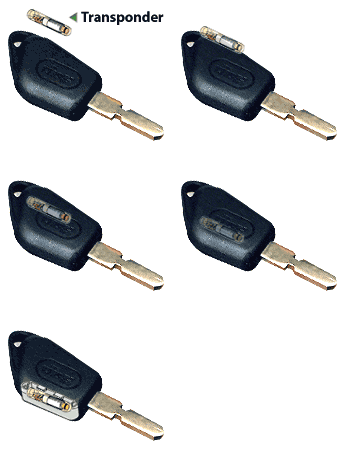
A transponder key is a car key containing a small electronic transponder that communicates with the vehicle's anti-theft system. The word transponder comes from the functions of transmitting and responding.
The transponder is commonly located inside the plastic head of a traditional key or inside the housing of a remote-head, flip, or smart key. It carries electronic identification that the vehicle uses during the starting authorization process.
Transponder keys have been used by numerous manufacturers, including Ford, Chevrolet, Toyota, Honda, Hyundai, Kia, Chrysler, Nissan, and many others.
How Does a Transponder Key Work?
When a transponder key is used to start the vehicle, the immobilizer system attempts to electronically identify the key. An antenna or reader associated with the vehicle's security system communicates with the transponder inside the key.
The transponder responds with electronic identification. The vehicle's security system checks that information against the keys it is authorized to accept.
If the key is recognized, the immobilizer permits the normal starting process. If the transponder is missing, incompatible, or not recognized, the vehicle may prevent the engine from starting.
This communication occurs automatically. With a properly programmed key, the driver normally does not need to perform any additional action.
What Is an Immobilizer?
An engine immobilizer is an electronic anti-theft system designed to prevent unauthorized engine starting. The transponder key is one component of that system.
Depending on the vehicle, starting authorization can involve communication between the key, immobilizer, body control module, ECU, and other electronic modules.
This explains why a mechanically correct key can sometimes turn an ignition but still fail to start the engine. The blade may operate the mechanical lock while the electronic portion of the key has not been authorized.
How Do I Know If My Key Has a Transponder?
You cannot always determine whether a key contains a transponder simply by looking at it. Many transponder keys have a relatively large plastic head, but appearance alone is not a reliable test.
Better ways to identify the key include:
- Check the owner's manual for information about the vehicle's immobilizer or security system.
- Identify the vehicle by its year, make, and model and determine which key system it uses.
- Have the key checked with appropriate automotive key-identification equipment.
- Ask an automotive locksmith or dealership to identify the key application.
The vehicle's Vehicle Identification Number (VIN) can also help identify the exact vehicle when researching the correct replacement key.
Some older vehicles were available with different key systems depending on model year, trim, production date, or market, so identification by appearance alone should be avoided.
Types of Transponder Keys
A transponder is not limited to one particular key shape. The technology can be incorporated into several types of automotive keys.
Standard Transponder Key
A standard transponder key resembles a traditional mechanical ignition key but contains an electronic chip inside its plastic head. It normally has no remote-control buttons.
Remote-Head Key
A remote-head key combines the mechanical blade, transponder, and remote-control buttons in one housing. The buttons may operate functions such as lock, unlock, trunk release, or panic.
Flip Key
A flip key has a blade that folds into the remote housing. Depending on the vehicle, the housing can contain both the remote electronics and the immobilizer transponder.
Laser-Cut Transponder Key
Many later automotive keys combine a transponder with a laser-cut or sidewinder blade. The blade style and transponder are separate aspects of the key: one operates the mechanical lock while the other participates in electronic starting authorization.
Smart & Proximity Key
Modern smart keys use electronic authorization without requiring the driver to insert a conventional key blade into the ignition. Although their operation is more advanced, immobilizer-related electronic identification remains an important part of the vehicle's security system.
Transponder Key Cutting
Making a working transponder key usually involves both key cutting and electronic programming. These are separate operations.
The mechanical blade must first match the vehicle's locks. Depending on the vehicle, this may be a conventional edge-cut blade or a high-security laser-cut blade.
Cutting the blade correctly does not automatically make the transponder functional. A newly cut key may unlock a door or turn an ignition while still being unable to start an immobilizer-equipped vehicle.
Transponder Key Programming
Transponder key programming allows the vehicle's immobilizer system to recognize an appropriate electronic key.
The programming procedure varies considerably between manufacturers, models, years, and immobilizer systems. Some vehicles provide procedures for adding another key when the required working keys are already available. Other vehicles require automotive key-programming or diagnostic equipment.
Programming should not be confused with cutting. The mechanical blade and electronic transponder perform different functions, and both must be correct when the vehicle requires them.
Some remote-head keys can also involve separate remote and immobilizer functions. Programming the buttons and programming the transponder are not necessarily the same procedure.
How to Duplicate a Transponder Key
If you already have a working key, making a duplicate car key is generally simpler than replacing every key after they have been lost.
A complete transponder-key duplicate normally requires:
- The correct replacement key or compatible transponder
- The correct mechanical blade cuts
- Electronic authorization for the vehicle's immobilizer system
Depending on the vehicle and key technology, the electronic portion may be added through an applicable programming procedure or other supported replacement method.
Because two keys that look alike may contain different electronics, always verify compatibility with the exact vehicle before purchasing a replacement key.
What If All Transponder Keys Are Lost?
An all keys lost situation is different from making a duplicate while a working key is available. A new mechanical key must be originated rather than copied from an existing blade, and an appropriate transponder must be authorized for the vehicle.
The VIN can help identify the exact vehicle and may be used when researching vehicle-specific key information. Proof of ownership may be required before replacement-key information or service is provided.
After the correct replacement key has been identified and cut, the electronic portion must be handled according to the vehicle's immobilizer system.
A dealership is one option, but towing the vehicle is not always necessary. A mobile automotive locksmith with the appropriate equipment may be able to provide car key replacement at the vehicle.
Depending on the vehicle and immobilizer system, lost keys may also be removed from the vehicle's authorized-key memory during the replacement process.
Common Transponder Key Problems
A car that does not recognize its transponder key may display a security or key warning and may refuse to start. However, a no-start condition does not automatically mean the transponder is defective.
Possible key-related problems include:
- Incorrect replacement key
- Incompatible transponder
- Unprogrammed replacement key
- Damaged key or transponder
- Vehicle immobilizer or antenna problem
- Communication problem involving a security-related module
If another known working key starts the vehicle normally, the problem may be associated with the first key. If none of the authorized keys work, the vehicle itself may require further diagnosis.
Transponder Key FAQ
Does every car key have a transponder?
No. Older vehicles and some key applications use mechanical keys without electronic transponders. Transponder systems became increasingly common as manufacturers adopted electronic immobilizers.
Where is the transponder chip located?
On a traditional transponder key, the chip is usually contained inside the plastic key head. On remote-head, flip, and smart keys, the electronic components are contained within the key or fob housing.
Can a transponder key unlock the door without programming?
If the blade is mechanically correct, it may operate a corresponding mechanical door lock even if the transponder is not electronically authorized. Starting the engine is a separate function on an immobilizer-equipped vehicle.
Can a transponder key be copied?
Yes, replacement transponder keys can be made for many vehicles. The process can involve cutting the blade and providing electronic compatibility with the vehicle's immobilizer system.
Does cutting a transponder key program it?
No. Cutting and programming are different operations. Cutting creates the mechanical blade pattern, while programming or other supported electronic authorization allows the vehicle to recognize the transponder.
Can a transponder key lose its programming?
A no-start condition should not automatically be attributed to a key "losing programming." A damaged key, incompatible replacement, immobilizer fault, electrical problem, or other vehicle issue can produce similar symptoms and should be diagnosed appropriately.
What happens if I use an unprogrammed transponder key?
The blade may operate the mechanical lock or ignition if it is cut correctly, but an immobilizer-equipped vehicle may refuse to start because it does not recognize the transponder.
Do transponder keys have batteries?
Traditional immobilizer transponder chips generally do not require the replaceable battery used to operate remote-control buttons. A remote-head key can therefore have a battery for its remote functions while its immobilizer transponder operates separately.
Is a transponder key the same as a key fob?
Not necessarily. A key fob commonly refers to an electronic remote used for functions such as locking and unlocking doors. A transponder is specifically associated with electronic vehicle identification and immobilizer authorization. Both functions can be combined in the same key housing.
